


The Abbott Sisters: Edith and Grace
15-minute read
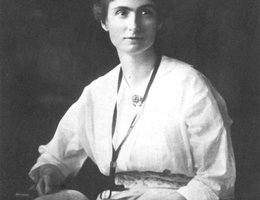
Edith Abbott ca. 1910
Public Domain Image | Wikimedia Commons
Introduction
Edith and Grace Abbott, sisters from Grand Island, were pioneers in the field of social work. From the 1910s to the 1930s, the sisters fought for a United States where immigrants are welcome and where children have the right to a childhood free of industrial work. Combining rigorous study with compassion earned growing up on the Plains, the Abbotts lifted social work in the United States beyond disorganized acts of charity into a profession backed by scientific research and academic training.
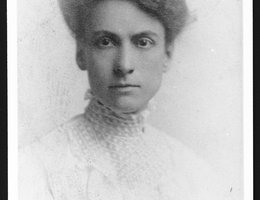
Grace Abbott, a teacher at Grand Island High School, Grand Island, Nebraska ca. 1900
University of Chicago Photographic Archive
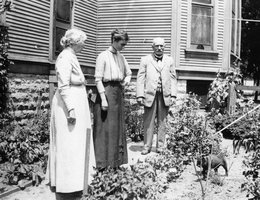
In Grand Island, Nebraska, Edith Abbott (center) looking at a cat in the garden with parents Othman A. Abbott and Elizabeth Griffin Abbott
University of Chicago Photographic Archive
Early Life on the Plains
Edith Abbott was born in Grand Island, Nebraska on September 26th, 1876. Grace followed on November 17th, 1878. They were the second and third of Othman Ali “O.A.” Abbott and Elizabeth “Lizzie” Griffen Abbott’s four children. The Abbotts had settled in the small railroad town along the Union Pacific line in 1873, in its earliest days. O.A., an attorney specializing in homestead claims, drafted Grand Island’s first town charter.
Today the city is Nebraska’s fourth largest, with a population of more than fifty thousand, but Edith and Grace Abbott’s Grand Island was a small, rural town. Fewer than a thousand people lived in the entirety of Hall County, and Grand Island itself comprised only a handful of houses, one general store, a restaurant, billiard hall, and saloon. As adults, Edith and Grace would credit life on the plains with teaching them tenacity, resilience, and work ethic. Their later social work was informed by the “frontier tradition” of helping neighbors in need, and time spent with Grand Island’s German community and Pawnee people from the nearby reservation gave them an appreciation for people from different walks of life.
The Abbott Sisters were brought up in a home that valued both learning and social justice. Both parents were abolitionists, and O.A. had fought for the Union in the Civil War. Edith and Grace’s mother Lizzie came from a Quaker family who had been involved with the Underground Railroad. Lizzie, with O.A.’s support, spearheaded the 1882 campaign for women’s suffrage in Nebraska and hosted such guests as Susan B. Anthony and Lucy Stone in the Abbott household.
Both children, especially the shy and bookish Edith, excelled in their education. Their college-educated parents encouraged debate and political discussion at home, a favorite of the outspoken and “contrary” Grace. The shelves of the family home were stocked with books for the girls to read—Lizzie eventually founded Grand Island’s first public library, which she helped to run for much of her life. As an adolescent, Edith attended boarding school at Brownell Hall in Omaha. The economic depression of the 1890s prevented Grace from following, but she completed her education at Grand Island High School. Both girls continued their education, Edith at the University of Nebraska, and Grace at Grand Island College.
As young women, Edith and Grace worked as teachers. Edith taught high school in Grand Island and Grace in Broken Bow. Eventually, Edith accepted a teaching post in Lincoln, and Grace returned to Grand Island after a bout with typhoid fever. She took over Edith’s old teaching position, coached basketball, and directed theater productions at Grand Island for nearly ten years.
Listen as Edith Abbott describes the sisters' childhood in Grand Island. From the 2003 radio program, The Children's Champion by the Abbott Sisters Project, originally aired on Nebraska Public Radio. (Transcript)
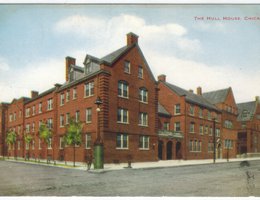
Postcard Picturing The Hull House ca. 1877
Public Domain Image | Wikimedia Commons
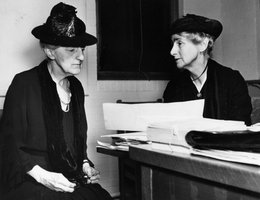
Sophonisba Breckenridge (Left) with Edith Abbott
University of Chicago Photographic Archive
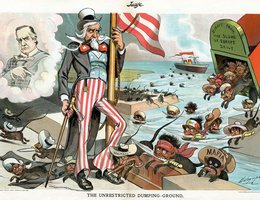
This 1903 cartoon depicts some of the suspicions and prejudices faced by Eastern European immigrants during the Progressive Era.
Cartoon by Louis Dalrymple | Wikimedia Commons
At the Hull House
Edith was the first to leave Nebraska when she traveled to the University of Chicago to study economics. There she took a course on the economic status of women taught by Sophonisba Breckinridge, a trailblazer among Chicago’s growing school of women sociologists and social workers. “Nisba” and Edith would share a lifelong love and professional partnership. After earning her doctorate in 1905, Edith spent several years teaching and studying in Boston, Washington D.C. and England.
Grace began her studies in political science at the University of Chicago in 1908. The University appealed to both Abbotts in part because it was one of the few Universities in the United States to offer graduate education to both men and women. At the turn of the century, it was common for men and women to attend separate colleges, and graduate opportunities for women were few.
Only a few months after Grace came to Chicago, Edith returned at Breckinridge’s invitation. Both sisters moved into Jane Addams’ Hull House where they would live for much of the next decade. Established in 1889 in Chicago’s poor, crowded, Near West Side, the Hull House was the poster child of the settlement movement. There volunteers, mostly young professionals and tradespeople, shared living spaces and organized social gatherings, educational opportunities, and economic assistance to the neighborhood, not as charity, as Jane Addams often said, but as neighbors. It was also a humming center for social research, which attracted both Abbott sisters.
The Hull House exemplified the reform movements that emerged in the United States during the Progressive Era of the early 20th century. The Progressive Movement aimed to address a host of problems in American society including:
- corruption and the influence of money in government
- unsanitary living conditions in growing cities
- poverty and concentration of wealth in the hands of the few
- and unsafe, unregulated working environments
America’s growing and changing immigrant population fueled the Progressive Movement. The United States has always been a nation of immigrants, but around the turn of the century, two major changes took place in immigration patterns. First, the number of people entering the United States increased substantially as more immigrants sought work in America’s expanding industrial economy. Second, more immigrants were arriving from Eastern European countries such as Italy, Russia and Poland, fleeing struggling agricultural economies as well as political and religious persecution. Many were Catholics or Jews, and few spoke or read English.
Often subject to suspicion and discrimination, the new immigrants of the early 1900s frequently held dangerous, low-paying jobs and lived in the most crowded, least sanitary tenement housing. With little knowledge of their new environment, and even less political representation, new immigrants were easily deceived, taken for what little money they had, and left stranded with no contacts in an unfamiliar place. The government left institutions like the Hull House, which neighbored Italian, Greek, Bulgarian, and Jewish communities, to aid immigrants, and this was the focus of much of the Abbotts’ work.
From 1908 to 1917, Grace Abbott served as the director of the Immigrants’ Protective League, which provided assistance to Chicago’s immigrants and advocated for their protection. Under her leadership, the League established a house near Chicago’s train station to help immigrants arriving in the city for the first time. Using rosters from Ellis Island, she met with families to get their children in schools and out of factories. She wrote a weekly column in the Chicago Evening Post, sharing stories of the city’s immigrant communities. Grace also appeared in courts of law to defend immigrants from deportation and to support immigrant women who had survived trafficking and sexual assault.
Edith also supported immigrants and many others during her time at the Hull House. She had been invited back to Chicago to lead the Department of Social Investigation at the Chicago School of Civics and Philanthropy, one of many social work trade-schools across the United States. Alongside Breckinridge, Edith carried out and published research on living conditions in Chicago’s tenements, the conditions of county jails, and causes of truancy in Chicago’s juvenile court. Her first book, Women in Industry, published in 1910, demonstrated that women had contributed to the nation’s economy longer than commonly believed and observed that women’s rights differed between social classes. Her work transformed the field of economics, which had not previously treated women’s labor as worthy of study.
Read an excerpt from Edith Abbott's Women in Industry
Like their parents, both sisters fought for women’s suffrage. They campaigned for partial suffrage in Illinois in 1913, and then to expand the right to women in other states—Grace even returned to Nebraska to support an attempted suffrage law. (Nebraska did not extend the right to vote to women until the ratification of the 19th amendment in 1920.) In response to the common criticism that women would simply copy their husbands’ votes, Edith published research on Chicago’s primary elections which demonstrated that women did express different political preferences than men and could change the outcomes of elections.
When the United States entered the First World War in 1917, the Progressive Movement fizzled. Calls for reform had difficulty competing with wartime demands for loyalty and patriotism, and concerns for immigrant well-being faded as immigration from Europe virtually came to a halt. Grace was active in the anti-war movement, serving as a delegate to the International Conference of Women at the Hague in 1915, but much of the other work that demanded the Abbotts’ attention slowed.
Edith and Breckenridge continued their research at the School of Civics and Philanthropy— in 1920, they led its merger into the University of Chicago as the Graduate School of Social Service Administration, the first such school to be affiliated with a major university. In 1924, Edith was named Dean, a role in which she served until 1941. Meanwhile, Grace was pulled away for work in a bigger arena.
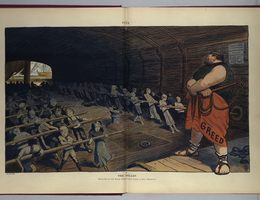
A 1909 cartoon in Puck Magazine opposing child labor
Cartoon by Arthur Young | Library of Congress
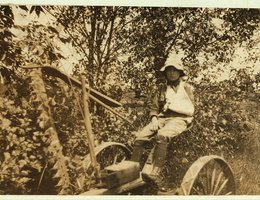
Beginning in 1908, photojournalist Lewis Hine captured thousands of photos of child labor across the U.S. for the National Child Labor Committee. This photo shows 12-year-old Clinton Stewart, who lost his hand to a mowing machine.
Photo by Lewis Hine | Library of Congress
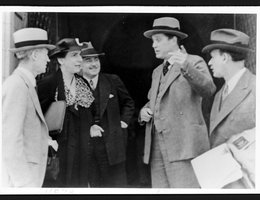
Grace Abbott Speaking to Others at the International Labor Organization conference in Geneva, Switzerland, 1935
Nebraska State Historical Society
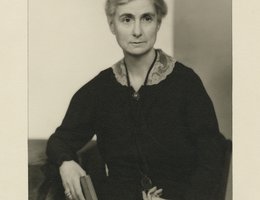
Edith Abbott, Dean of the University of Chicago School of Social Service Administration
Photo by Fernand de Gueldre | University of Chicago Photographic Archive
Protecting America’s Children
In 1917, Grace left Chicago for Washington D.C. She had been called by Julia Lathrop, Chief of the United States Children’s Bureau and former Hull House resident. The Bureau was founded in 1912 “to investigate and report upon all matters pertaining to the welfare of children and child life among all classes of our people.” Lathrop had summoned Grace to lead the Bureau’s Child Labor Division and administer the recently passed Keating-Owen Act, which banned the interstate trade of products made with child labor and restricted the hours in which minors could legally work.
Child labor was a growing concern for Americans in the 1910s. Children younger than sixteen worked in factories, mines, farms, and textile mills. Laws treated children as property of their parents with few rights of their own, so they could be paid less than adults and lacked legal protection in the workplace. Though families surviving on poverty wages often welcomed the extra income, these jobs were dangerous to life and limb, and they deprived children of the education they would otherwise be getting in school.
In agricultural economies like Nebraska’s children took on a share of farm work. Living on the Plains was a challenge requiring all the help available, and hired labor was expensive, if in supply at all. Children were frequently responsible for herding and caring for livestock, husking corn, or cooking and cleaning in the home. While farmwork afforded children time outdoors and valuable learning experiences, it pulled them from school, especially in the Spring and Fall. Labor was regularly unsupervised, and animals, farm machinery, and open flames created plenty of risk for serious injury. The few child-labor laws that existed in the early 1900s focused on child labor in factories and mines, leaving farms overlooked. For example, child labor was so widely accepted in rural Nebraska that children were required to attend as little as twelve weeks of school a year at only 8 hours a week, far less than their peers in Omaha or Lincoln.
In her time at the Children’s Bureau, where she became Chief in 1921, Grace Abbott made strides toward ending child labor in the United States. Under her leadership, the Bureau convinced the military to end child labor in its contracts and bases. She worked with organizations across the country to develop legal standards for child labor, child and maternal health, and children with disabilities that were rooted in science and academic research. The Bureau communicated research about children’s needs to parents through conferences, publications, posters, and a weekly radio show which Grace hosted on NBC and CBS. In 1923, Grace led a national movement for an amendment to the United States constitution giving Congress the power to “limit, regulate, and prohibit the labor of persons under eighteen years of age.” The amendment was rejected by the states, and child labor would not be banned nationally until 1938, in part due to the Abbotts’ work.
Read an excerpt from Grace Abbott's speech, "The Washington Traffic Jam"
Of the two sisters, Grace has received most of the attention and praise for her role in fighting child labor; however, the Abbotts worked in close collaboration throughout their careers. Each relied on the other for their success. Biographer Lela B. Costin describes the sisters’ working relationship:
Edith Abbott by all accounts was a scholar, ‘an intellectual down to her finger tips.’ Grace Abbott also possessed a keen intellect, but she was more disposed to action and was the moving force in implementing the ideas the sisters generated. Their relationship was congenial, based on loyalty and trust.
Edith, from her position at the University of Chicago, steered promising students into positions at the Children’s Bureau. The Bureau occasionally contracted with Edith and her students to conduct research for the federal government. Grace published some of Edith’s research, and likewise, The Social Service Review, which Edith founded in 1927 along with Breckenridge, allowed Grace to publish ideas under Edith’s name that she could not easily share herself as head of a government agency. In 1933, the sisters were reunited as Grace, after struggles with tuberculosis, retired from the Children’s Bureau and took up a faculty position in the School of Social Service Administration.
Listen as Grace Abbott describes the challenges of securing government funding for children's programs in a 1931 speech. From the 2003 radio program, The Children's Champion by the Abbott Sisters Project, originally aired on Nebraska Public Radio. (Transcript)
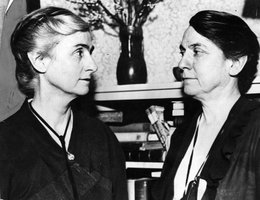
Edith Abbott (left) and Grace Abbott
University of Chicago Photographic Archive
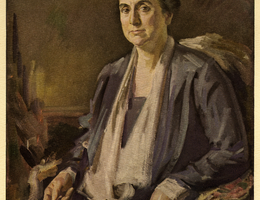
Watercolor Portrait of Grace Abbott, 1931
Art by Leon Gordon | Nebraska State Historical Society
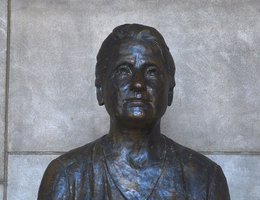
Grace Abbott Bust in the Nebraska Hall of Fame
Photo by Capitolist | Wikimedia Commons
The Abbott Sisters’ Legacy
The need for quality social work exploded as the Great Depression gripped the country in the early 1930s. Both sisters, Edith as the Dean of a premiere graduate college and Grace with her connections throughout the federal government, helped to shape the field of social work in America. Grace’s influence can be seen in several New Deal programs, especially the Social Security Administration. Meanwhile, Edith elevated her students to leadership positions in social work organizations across the country.
In April of 1938, Grace was diagnosed with multiple myeloma which resulted in her death the following year. Edith, devastated by grief, retired from her position as Dean but continued her work teaching and editing The Social Service Review. She also began work on a biography of her sister. While she did not complete it before her own death in 1957, her notes were compiled and edited by Grand Island native and Abbott scholar John Sorenson and published in 2015.
Grace Abbott was inducted into the Nebraska Hall of Fame in 1976 “for her courageous championship of children and mothers, and for her promotion of pioneer legislation of enduring benefit to U.S. citizens.” The University of Nebraska at Omaha’s Grace Abbott School of Social Work carries on the Abbotts’ commitment “to programs that safeguarded mothers and families, protected immigrants from abuse, and rescued child laborers.” Likewise, Grand Island’s Public Library, established by the Abbotts’ mother Lizzie, now bears Edith’s name. In 1992, the library launched The Abbott Sisters Project, led by Sorenson, which has worked to preserve and communicate the Abbotts’ legacy.
It is no understatement to say that the foundations of professional social work in the United States were built in large part by the Abbott Sisters. While many of the social ills the Abbotts fought still exist today, Nebraskans can look to the sisters as models of how to continue improving our communities with intelligence and compassion.
Updated September 3, 2026
Glossary
social justice—the idea that society should be structured so that all its members are treated fairly and equitably in respect to things like wealth, opportunity, and protection of the law
women's suffrage—the right of women to vote. Women in the United States gained suffrage nation-wide in 1920 after the Suffrage Movement pushed for the 19th amendment to the Constitution.
sociology—the scientific study of human behavior, relationships and interactions in large groups, especially in societies
social work—the professional work of helping individuals, families and communities in a society meet basic needs like food, shelter, and healthcare
Hull House—a settlement house in Chicago, Illinois founded by Jane Addams and Ellen Gates Starr in 1889. Hull House was the most famous and influential piece of the settlement movement.
settlement movement—a global movement that existed around the turn of the 20th century. Settlement reformers established houses in poor urban areas where volunteers would live and provide services to the local community.
reform—to change for the better, improve by modifying
Progressive Movement—a social and political movement that emerged during the turn of the 20th century in the United States. This period of U.S. History between the 1890s and 1920s is often referred to as the Progressive Era. Progressives advocated reforms of government and society, especially to regulate industry and combat government corruption.
New Immigrants—Immigrants who came to the United States from the beginning of the 1900s to the first World War. More immigrants came to the U.S. during this time than in the previous 40 years combined. Many were from Eastern European countries like Italy, Poland and Russia.
tenement—a large building containing multiple housing units. In the United States, "tenement" is usually used to refer to housing that is of particularly poor quality, crowded, and unsanitary.
Immigrant's Protective League—a community organization that grew out of Chicago's Hull House and Women's Trade Union League that provided direct aid and legal advocacy for the city's immigrant population
Ellis Island—the largest immigrant inspection and processing point in the United States, located in New York Harbor. The vast majority of immigrants from Europe entered the U.S. through Ellis Island in the early 20th century.
trade school—also called a vocational or technical school, an institution that trains individuals to work in a particular profession. Trade schools tend to focus less on theory and research than colleges and universities, and more on practical skills.
Chicago's Graduate School of Social Service Administration—One of the first graduate schools of social work to be affiliated with a major university. It is now known as the Crown Family School of Social Work, Policy, and Practice.
Dean—in colleges and universities, a title that refers to the head of a school or department.
Children's Bureau—a federal agency founded in 1912 under the Department of Labor tasked with investigating and reporting on matters related to the welfare of children. The Children's Bureau now operates under the Department of Health and Human Services.
child labor—Children's participation in work that interferes with their normal physical, mental, or social development.
Keating-Owen Act—the first major attempt by the United States government to reduce child labor. It banned the interstate sale of goods made using child labor and limited the hours children could work. The bill was passed in 1916 and went into effect in 1917. It was ruled unconstitutional one year later.
Great Depression—a worldwide economic crisis that began in 1929 and continued throughout the 1930s. Americans experienced high unemployment, low wages, and business failure.
New Deal—a collection of government programs implemented under the administration of President Franklin D. Roosevelt that attempted to provide relief during the Great Depression, push the economy to recover, and reform the economic rules that caused the collapse.
Reflection Questions
- CONTINUITY AND CHANGE: How did the practice of social work change as a result of Edith and Grace Abbott's work?
- CONTEXTUALIZATION: How does the Abbotts' work with immigrants and children relate to the goals of the larger Progressive Movement?
- RELEVANCE: The Abbott Sisters worked to bring attention to problems that American society ignored. What problems in society do you think deserve more attention today?
References
“Abbott Sisters Project.” Grand Island Public Library, n.d. Accessed July 29, 2026.
Costin, Lela B. “Grace Abbott of Nebraska.” Nebraska History, no. 56 (1975): 164–90.
—. Two Sisters for Social Justice: A Biography of Grace and Edith Abbott. University of Illinois Press, 1983.
Fitzpatrick, Ellen. Endless Crusade: Women Social Scientists and Progressive Reform. Oxford University Press, 1990.
Hickey, Donald R., Susan A. Wunder, and John R. Wunder. Nebraska Moments. University of Nebraska Press, 2007.
Jabour, Anya. Sophonisba Breckinridge: Championing Women’s Activism in Modern America. University of Illinois Press, 2019.
Lengermann, Patricia, and Jill Niebrugge-Brantley. The Women Founders: Sociology and Social Theory 1830-1930. McGraw-Hill, 1998.
Muncy, Robyn. Creating a Female Dominion in American Reform 1890-1935. Oxford University Press, 1991.
Naugle, Ronald C., John J. Montag, and James C. Olson. History of Nebraska. University of Nebraska Press, 2014.
Sorensen, John, ed. A Sister’s Memories: The Life and Work of Grace Abbott from the Writings of Her Sister, Edith Abbott. University of Chicago Press, 2015.
—. “Abbot, Edith (1876-1957).” Encyclopedia of the Great Plains, n.d. Accessed June 4, 2026.
—. “Abbot, Grace (1878-1939).” Encyclopedia of the Great Plains, n.d. Accessed June 4, 2026.
—. Grace and Edith Abbott: Nebraska’s Social Justice Sisters. Nebraska Research, 2019.
The Abbott Sisters Project. The Children’s Champion. Aired 2003, on Nebraska Public Radio.
UNLADYLIKE2020, dir. Grace Abbott. Unladylike Productions, LLC, 2020.
About the author: Shane Adams is a K-12 Education Specialist at Nebraska Public Media and former high-school history teacher. He holds an M.A. in History and M.S. in Secondary Education from the University of Nebraska at Omaha.