


Nebraska Beef Goes Global
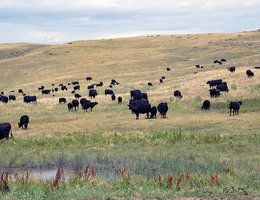
Cattle in the Sandhills
Courtesy Moni Hourt, from the 2008 NET Television program, Beef State
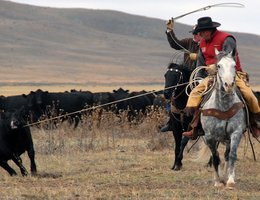
Cowboys rounding up cattle
From the 2008 NET Television program, Beef State
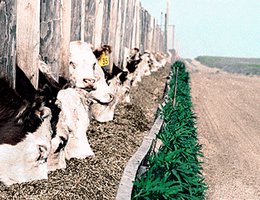
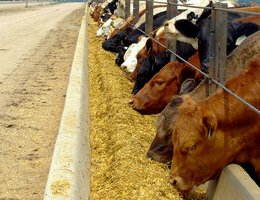
Cattle eating grain at fence row
Photo by Brian Prechtel. Courtesy U.S. Department of Agriculture, k5643
Beef State in the 21st Century
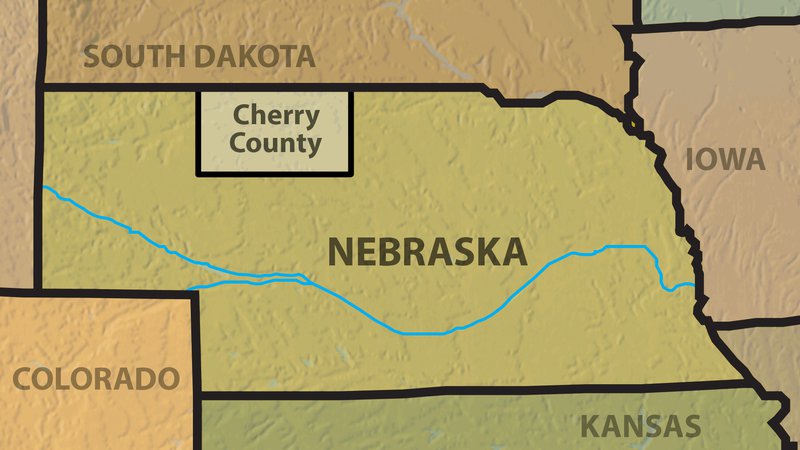
Nebraska entered the 21st century with impressive statistics. As of 2006, Nebraska had the top three beef cattle counties in the U.S., including the nation’s No. 1 cattle county — Cherry County, with nearly 165,000 cattle. Holt County was No. 2 (101,000) and Custer County was No. 3 (93,000). Also among the top counties in the nation was Lincoln County at No. 15 (69,000).
Four Times as many Cattle as People
January 2006 figures showed that Nebraska continued to have far more cattle than people. Cattle outnumbered Nebraskans nearly 4 to 1. There were 1.93 million cattle but just 1.7 million Nebraska residents. Those cattle plus the 4.7 million head that were sent here to be fed annually totaled nearly 6.64 million cattle.
The cattle industry continued to be Nebraska’s largest industry, with nearly $7 billion in sales. When you consider all of the other businesses that supported the cattle industry (like veterinary medicine), that number jumped to just over $12 billion.
There were about 4,500 feeding operations in Nebraska in the early 2000s. While some lots were enormous, nearly 800 of them took care of more than 1,000 animals. That meant there were over 3,700 feedlots that each held less than 1000 animals at a time. Nebraska led the nation in beef exports, and world trade was growing, linking Nebraska to a much larger global economy. But those exports were injured severely by a single sick animal.

Portrait of Mad Cow in Nebraska. . . Uh, there has never been one!
As of 2017, there have been no instances of Mad Cow Disease in cattle in Nebraska.
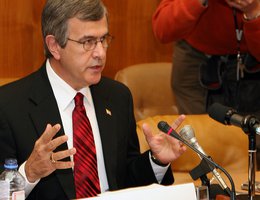
U.S. Secretary of Agriculture Mike Johanns addressed the United States Mission Genevam, 11/9/2005
Courtesy United States Mission to the United Nations and Other International Organizations in Geneva
"Sane" Cows
In December of 2003, a dairy cow in Washington State was found to have bovine spongiform encephalopathy (BSE). Because this illness may cause an animal to behave strangely and lose muscle control, consumers knew the disease by another disturbing nickname, "Mad Cow Disease." As of 2017, there have been no cases of Mad Cow Disease in cattle in Nebraska.
The United States Department of Agriculture (USDA) took a number of steps to insure the quality of American beef. They ordered a study by the Harvard Center for Risk Assessment to determine both the possible and actual threat to Americans. That study suggested that the physical threat was very small and that if certain steps were taken, cases of the disease would be rare.
In a USDA news release, Agriculture Secretary Mike Johanns (former Governor of Nebraska) announced that:
". . .the most likely number of cases [of BSE] present in the United States is between 4 and 7 animals. Therefore, USDA concludes that the prevalence of the disease in the United States is less that 1 case per million adult cattle, based on an adult cattle population in this country of 42 million animals."
– No. 0143.060, dated April 28, 2006
The biggest problem with BSE was not the threat to public health, but with trade. With the discovery of that one diseased animal, 30 countries quickly stopped buying American beef. Because Nebraska led the nation in beef exports, the impact of BSE on the state’s beef economy was dramatic.
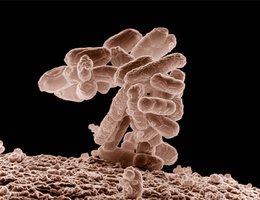
There were other challenges that the Beef State faced as it stepped into the 21st Century. For example, e. coli (a form of food poisoning) led to investigating the way products like hamburger were processed.
Bovine Spongiform Encephalopathy - U.S. Food and Drug Administration
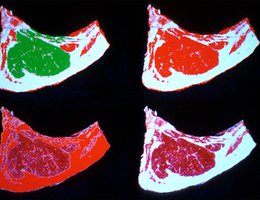
Analysis of computerized images of inch-thick ribeye steak helps predict the pounds of retail beef a carcass will yield after boning and trimming
Courtesy USDA Agricultural Research Service, K8645-17
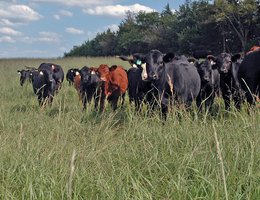
Grazing cattle in western Nebraska
Photograph by Christens, 2007.Courtesy The Nebraska Cattleman Magazine, 9-07 018
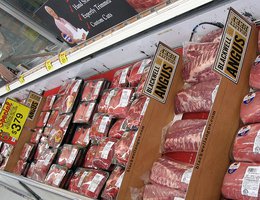
Specialty: "Blackwell Angus, Quality Beef". Array of beef at Sun Mart Grocery, Lincoln, NE, 2008
Courtesty NET Learning Services
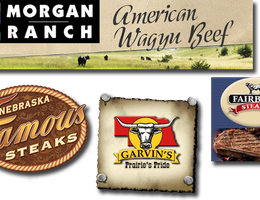
A few of the Nebraska companies that sold beef products at the beginning of the 21st century
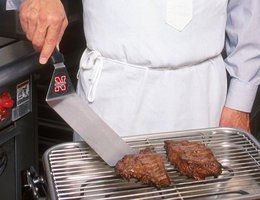
Researcher Chris Calkins grilling up a flat iron steak, 2008
Courtesy University of Nebraska Institute of Agriculture and Natural Resources
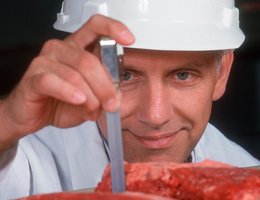
Researcher Chris Calkins inspecting a flat iron steak
Courtesy University of Nebraska Institute of Agriculture and Natural Resources
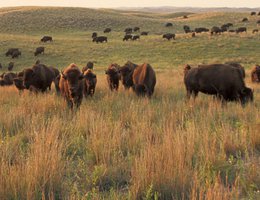
Bison on a Nebraska ranch owned by Ted Turner, mid-1990s
Courtesy Nebraskaland Magazine, Nebraska Game and Parks, BUFF06 BG0002+01
Special Markets
Issues related to the environment, use of drugs and chemicals, and other problems shaped not only public policy, but consumer demand. In meeting these challenges, new and expanding niche markets for cattle grew.
Since the first days of cattle in Nebraska, producers have worked to keep up with the wishes of their consumers. Breeding and feeding technologies were developed to produce the tasty meat that Americans and people around the world wanted.
Most cattle in Nebraska belong to the Angus and Hereford breeds, but there are more than a dozen other breeds in our state. Some ranchers also raised their animals in special ways. A few ranchers raised cattle that were fed only on grass and never fattened with corn. Others raised animals without drugs or chemicals like antibiotics and hormones.
In the first few years of the 21st century, over 3,000 new products had been developed that made preparing beef easier and faster. Some beef products were already seasoned or marinated so there were many new flavor choices. Advances in freezing and transportation technologies allowed businesses to ship frozen meat anywhere in the world.
One important new idea came from researchers at the University of Nebraska. Dr. Chris Calkins, a meat scientist, and other researchers at the University of Nebraska and the University of Florida, were studying meats that were less popular. They were normally used for roasts or ground meat.
Dr. Calkins found a muscle in the front shoulder that his tests showed was quite tender. When Dr. Calkins cut that tender muscle from a piece of meat that would normally have been a roast, he found that he had invented a new steak: the flat iron steak. The flat iron steak quickly became popular because of its flavor, tenderness, and the way it easily took up marinades. The Nebraska “discovery” is now in many restaurants.
To get a sense of the range of special markets and special issues, you can look at the websites of organizations that support the Nebraska beef industry, like:
At the dawn of the 20th century, cattle had replaced bison on Nebraska’s prairies, and the type of large ranchers who ran their cattle over hundreds of thousands of acres of government land were long gone. However, Ted Turner (a nationally famous TV station owner) privately owned ranches in the western part of the U.S. with over 400,000 acres in Nebraska . . . on which he raised only bison! Turner’s ranches made him Nebraska’s largest landholder, and another contributor to the special niche markets.
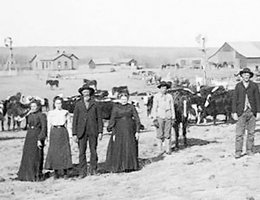
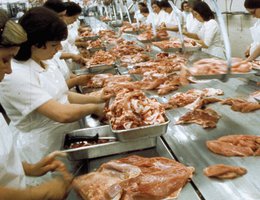
Hispanic workers in a rural U.S. meatpacking plant
Courtesy Joe Valbuena, U.S. Department of Agriculture
Hispanic Migration
Modern-day vaqueros still possess remarkable skills in roping, branding, and rounding up cattle. Find out more about the Spanish influence on cowboy culture at a Mexican Rodeo in Springfield, Nebraska. From the 2003 NET Television series Next Exit
The story of beef is the story of a migration from south to north. Cattle came to North America with the Spanish in 1493. The large herds that roamed the Texas plains descended from the Spanish cattle, and many of those cowboys who pushed cattle into Nebraska in the 1870s were Mexican. Between 1900 and 1929, large numbers of Mexicans came to Nebraska. They left their home country because of political and economic problems. They found jobs in the beet fields of western Nebraska as well as the stockyards and packing houses, mostly in South Omaha.
In the 1990s, Nebraska saw enormous growth in the number of Hispanics (mostly Mexicans, Guatemalans, and Salvadorans). The term Hispanic refers to anyone who speaks Spanish as his or her original language, or is descended from someone who did. Hispanics could be American-born or from many different Spanish-speaking countries all over the world. These Hispanics were looking for jobs. The packing houses, which had moved into smaller Nebraska communities, created a large number of jobs that needed little skill and paid fairly low wages. But the low wages were very attractive to immigrants who could make more in an hour here than they would make in a day back home.
Several communities across the state, including Lexington, Madison, Grand Island, and Schuyler, saw their populations swell. In Lexington and Schuyler, the 2000 U. S. Census showed that the Hispanic population neared 50%.
In his 2005 dissertation, Dr. Thomas Sanchez, a sociologist at the University of Nebraska at Omaha, looked closely at Schuyler, Nebraska. His work illuminates the causes and effects of the Hispanic migration.
Founded in 1887, Schuyler was populated with Czechs, Irish, and Germans, who tended to isolate themselves one from another. Meatpacking began in Schuyler in 1968 with the opening of Spencer Packing Company. Over the years Spencer expanded and changed ownership, but finally closed in 1982. The plant reopened in 1984, paying workers $5.90 an hour, $3.45 an hour less than employees had previously received. Ultimately, the operation was taken over by Excel (a subsidiary of Cargill).

The plant had always hired some Hispanics, but it wasn’t until the early 1990s that the population expanded dramatically. From 1990 to 1995, the number of Hispanics employed at Excel grew threefold. In 2004 Hispanic people held 85% of the jobs.
Dr. Sanchez noted that communities like Schuyler found themselves in upheaval. While the tax base and property values grew, the new citizens strained the educational system and other government services. The older citizens had long forsaken Czech and German as their first language, but the new arrivals spoke mostly Spanish. Earlier, aging and migration away from town had been shrinking these communities, and now the workforce was comprised mostly of the newcomers. While growing into a near majority, Hispanics found themselves outside the circle of community leadership, and their political power was constrained.
This polarization, coupled with open hostility towards newcomers from certain elements of the established population, caused tension within the community.
The beef industry depended heavily on the inexpensive labor provided by these immigrants. They had the same heritage as those who drove cattle into Nebraska over 100 years ago.
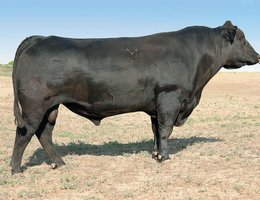
BREEDING: Angus bull
Photographer Jim Koch. Courtesy U.S. Department of Agriculture, K10380-1
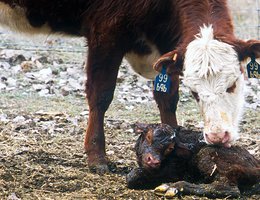
CALVING: Hereford cow and newborn calf
Photographer Scott Bauer. Courtesy U.S. Department of Agriculture, K9486-1
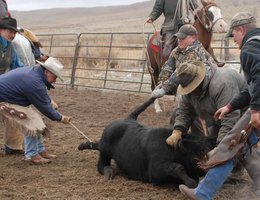
BRANDING: Cowboys roping and branding a calf
From the 2008 NET Television program, "Beef State"
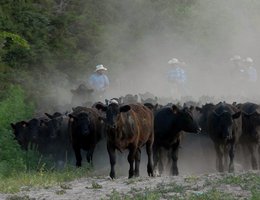
OUT TO PASTURE: Cowboys moving cattle down dirt road
From the 2008 NET Television program, "Beef State"
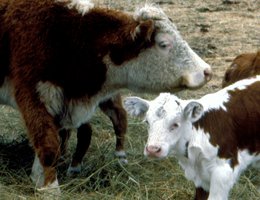
WEANING: Hereford cow and calves
Courtesy Nebraska State Historical Society, RG1668-S159-05
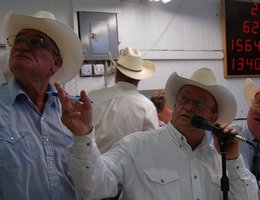
MARKET: Bassett, NE livestock auctioneers
From the 2008 NET Television program, "Beef State"
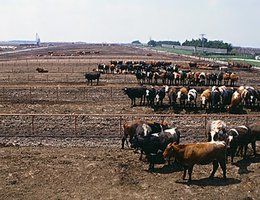
FEED LOTS: Large feed lot
Photographer John Nienaber. Courtesy U.S. Department of Agriculture, K8236-1
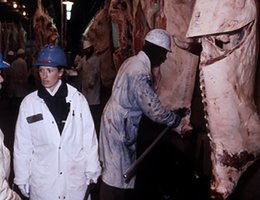
SLAUGHTER: Sides of beef hanging by Workers and inspector in a slaughter house
Courtesy Nebraska State Historical Society, RG1668-T13-4-20
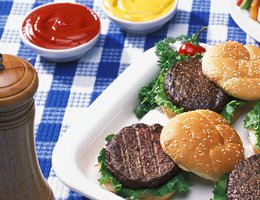
GROCERY STORE: Picnic with grilled hamburgers
Photographer Stephen Ausmus. Courtesy U.S. Department of Agriculture, k9988-1
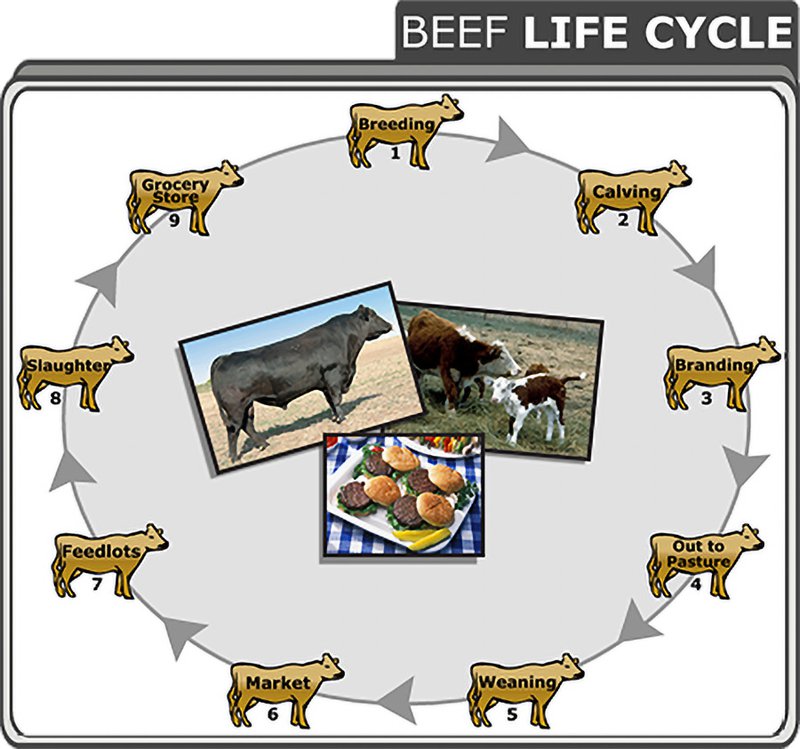
Beef Life Cycle
Producing beef takes longer than you might think. The production cycle, from the time a cattle breeder chooses his or her breeding stock to the delivery of beef to the consumer, spans nearly two years. Breeders, ranchers, feeders, processors, and distributors work within this cycle to keep grocery stores and restaurants well supplied to meet the needs of their customers.
Cattle & NE Cultures
Somewhere about a third of the way across Nebraska’s 430-mile expanse, there is an invisible line. On the eastward side of the line, people involved in cattle wear seed corn caps and boots with rounded toes. On the west, the caps yield to cowboy hats and the toes of the boots sharpen and the heels rise.
This line is imprecise and curvy. It does not coincide with other invisible lines: the one that divides Central Time from Mountain Time; the line that separates the telephone area codes 308 from 402; or even the 100th Meridian, the line of longitude that marks the moist east (with 20 inches of rain) from the arid west, where the rain diminishes.
History suggests the origins of this division. The western part of the state was born of people traveling from south to north, equestrian herders called cowboys. Those people to the east were principally people who journeyed from east to west, and whose heritage was that of farmer. There is also an occupational division. In the west on Nebraska’s vast grasslands, places like Cherry County, cattle are bred and raised, and toward the east, Cuming County for example, farmers raise abundant corn crops and feed cattle.
This line, of course, is porous. There are cowboys in the east and farmers in the west. But the cultural stamp is still there. Wisner and Valentine, seats of the counties mentioned above, are very different communities.
Omaha developed its own cattle culture around the now-gone stockyards. There, ethnic groups flourished and settled into established communities that endure. It was here that the cowboys and cattle feeders of rural Nebraska intersected with the buyers, sellers, and packers of the city. South Omaha was both urban and rural.
When the stockyards and packing houses in Omaha closed, replaced by rural packing houses, another cultural transformation emerged. In towns like Madison and Schuyler and Lexington, a new migration from south to north created a new cattle culture, one that spoke Spanish.
It is no surprise then to find that Nebraska was shaped, culturally, by its largest industry, cattle. Though never intended to define the state culturally, Nebraska truly is The Beef State.