
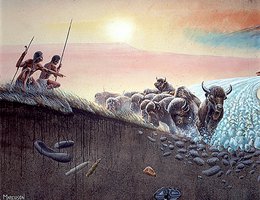
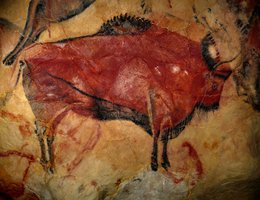
The first accepted evidence we have of human beings on the Central Plains is around 12,000 years old. Archaeologists have found spear points near Clovis, New Mexico, and elsewhere that date from that era. There is some evidence that human beings may have lived here even earlier, but that evidence is disputed. Most scientists believe the ancestors of today’s Native Americans walked across a "land bridge" from Asia to North America near the end of the great Ice Age. It is believed that what is now Russia and Alaska were connected by a strip of land that later sank beneath the northern Pacific Ocean. These early nomads on the Plains are now called Paleo-Indians. Scientists believe that Paleo-Indian culture was the dominate culture on the plains between 11,500 and 8,000 years ago.
The Paleo-Indians moved around a lot and hunted big game as their primary source of food. Some Paleo-Indian artifacts have been found near the bones of mammoth and large bison, the ancient form of buffalo. There is a lot to learn when archaeologists look at the bones and artifacts from the places where Paleo-Indians killed and butchered their prey. We know that they lived in small temporary camps and moved from place to place, probably following their prey. We know they hunted mammoths, camels, ground sloths, extinct forms of bison, and other animals. While they ate a lot of meat, Paleo-Indians also gathered plants to supplement their diets.
Sometimes they would drive mammoths over a cliff or into a muddy swamp area where the large animals would get "bogged down," making it hard for them to escape and easy for the Paleo-Indians to kill the mammoth. They used spears tipped with large, well-crafted rock points. These chipped stone points were typically large, leaf-shaped and stemmed. They are the most conspicuous and readily recognizable artifacts found for this period. There are a number of different styles of points that were produced, each with its own type name. The most famous and earliest being the Clovis and Folsom points. These points were named after Paleo-Indian cultures that lived in New Mexico but roamed up into Nebraska.
It’s hard to find evidence of the activities of these early Nebraska inhabitants because much of it is buried deep below the surface. Occasionally the remains of their kill sites and camps are uncovered by erosion or construction digs. Very little evidence of shelters has been found, and it is assumed that the tribes probably used simple skin tents or brush shelters. Few sites of this period have been excavated in Nebraska. It is clear from surface finds, however, that these people did range widely over the state.
Toward the end of the period, the weather in the region and the plants growing here shifted toward what we experience today — a plains grassland environment. Many of the large game species died and became extinct. The animal species that were left were largely that same species we find today. These changes altered the lives of the Paleo-Indians, and we can see those changes in the types of artifacts that are recovered.
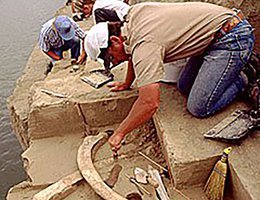
In 1987, archaeologists discovered a mammoth skeleton along the banks of Medicine Creek Reservoir in Frontier County. The site is known as the La Sena site. Radiocarbon dating techniques and the depth of the skeleton tell us the animal died 18,000 years ago. As they studied the skeleton, some scientists came to believe that early humans broke apart the mammoth to eat it and may have even killed it — some 6,000 years earlier than the Clovis and Folsom points are dated.
The fossil evidence they are looking at are bone flakes and the ways in which some bones were fractured. A new brand of scientific enquiry called taphonomy is providing the clues. Taphonomy is the multidisciplinary study of cultural and natural processes that may be responsible for the arrangement of objects found at an archaeological site. The La Sena skeleton had several bone flakes associated with it. These bone flakes were identical to the long, thin slivers of flint that have been documented as byproducts that flake off as humans chip stones to make sharp tools. So these early humans may have used stone tools to butcher the mammoth. In addition, some of the thick mammoth bones were split apart in ways that could only have happened with a heavy blow. They believe that the humans used large cobblestones to retrieve the nutritious bone marrow in the middle. Experiments with modern elephant bones splintered by rocks produced the same kinds of fractures, while studies of bones trampled by other elephants did not.
But not everyone accepts the evidence presented at the La Sena site. Skeptics say that the bone breaking evidence is not conclusive. And they are asked, "Why haven’t archaeologists found other evidence of human life at the La Sena site, like fire hearths, stone tools or stone debris?"
If the La Sena scientists are right, human beings were living and hunting here much earlier than we previously thought. From 12,000 years ago to 18,000 years ago is a significant difference. However, in the geologic time scale, humans are still a very recent introduction to the land that would become Nebraska.
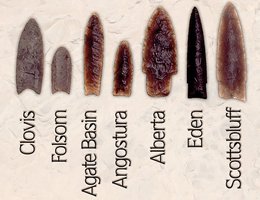
The oldest known Indian tool found in Nebraska is the Clovis point, made about 10,000 B.C.E. It is a spear point with a groove or flute, at its base. Attached to a shaft, this spear point was capable of penetrating an elephant’s hide. The Clovis culture takes its name from the town in New Mexico where the striking stone projectile point characteristic of this culture was first found. The chipped flint points known as Clovis points and a variety of additional stone tools artifacts are dated from 10,000 to 9,000 B.C.E. Its distinctive characteristics include a central groove, or flute, along both of its faces and finely worked edges.
The Folsom culture takes its name from Folsom, New Mexico. The artifacts recovered at this site included chipped flint points and a variety of other stone tools. The remains of large mammals, particularly extinct varieties of bison, were also found at this site. The remains date from 9,000 B.C.E. and 8,000 B.C.E. (or 11,000 to 10,000 years ago).
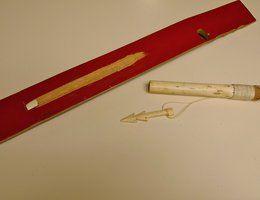
These points were actually integral parts of a weapons system. Points were usually fastened to a short foreshaft, and then that foreshaft was inserted into the body of the lance. When they were hunting big game like the mammoth, Clovis and Folsom people would probably thrust the weapon into the animal, breaking off the foreshaft. The sharp point and foreshaft would then be free to do further damage to internal organs, speeding the kill. Toward the end of the period, they also began using the atlatl, a hand-held throwing stick that increased the power of the spear.
Two of the Paleo-Indian point types, Meserve and Scottsbluff, were first found at, and named for, locations in Nebraska. Many other types of spear points have also been found in Nebraska — Plainview, Folsom, Hell Gap, Agate Basin, Alberta, Eden, Frederick, Lusk, and Brown’s Valley. Sites abandoned by some of these Paleo-Indian cultures have been excavated in western Nebraska.
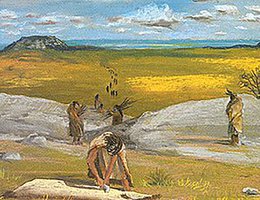
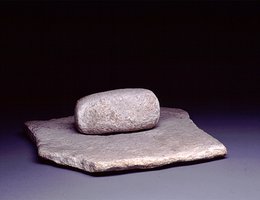
By 9,000 years ago, the last Ice Age had ended and the climatic patterns somewhat characteristic of the modern period were established. Many of the animals that had dominated the Plains during the Ice Age became extinct. Mammoths, camels, horses, and others all died out. People changed the way they lived in response to shifts in climate and available plants and animals. More diverse hunting was practiced, with both large and small game species killed. Wild plant resources were also exploited to a greater extent than during the Paleo-Indian tradition.
During this time period, a new weapon technology for hunting big game, the atlatl, was perfected. This is a hand-held throwing stick that, in effect, acted as an extension of the throwing arm. The atlatl boosted the range and speed that spears could be thrown. Evidence indicates that throughout the long Archaic Period, people experimented with the size and shape of the atlatl, the way it attached to the spear, and the materials it was made out of. Some even added weights — all to make the weapon more powerful.
People during the Archaic Period continued to migrate in search of food. Permanent villages have not been found in the archaeological record, although people may have returned to the same location from year to year. New types of tools appeared. Archaic Period people produced a variety of spear point styles, possibly representing distinct, localized cultural groups. These cultural groups have been recognized largely based on the types of chipped stone spear points found at animal kill sites. It appears that while these tribal people did move from place to place, they were more localized than during the Paleo-Indian period.
Life in Nebraska in the Archaic Period changed dramatically with the end of the Ice Age. Grasslands, a warmer climate, and an assortment of smaller animals similar to those of today, replaced the cool, damp climate, the forest areas and the large animals of the Ice Age. Gone too were the Folsom people, replaced by various Archaic cultures that occupied the plains from 10,500 to 8,000 years ago.

