
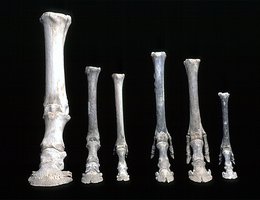
Imagine that you could be transported in a time machine to Nebraska 12 million years ago. You would walk out of your time machine into a very different world than the one you are used to.
For one thing, you would be the only human being in the landscape. Humans had not yet evolved, and so animals dominated a landscape covered with sub-tropical grasses and patches of jungle.
The area that became Nebraska was much warmer 12 million years ago than it is now. Animals living during the Miocene geologic era—which lasted from 23 million years ago to 5 million years ago—most likely never saw snow. Twelve million years ago, its most dominant feature would have been a flat terrain covered by an ocean of grass, interrupted by shallow stream valleys and clumps of forest.
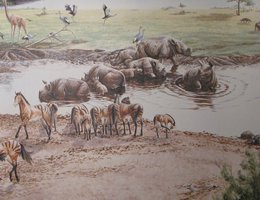
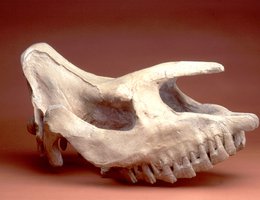
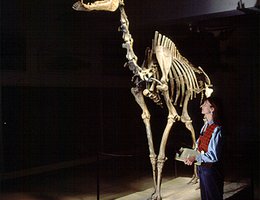
Animal life would have been present in stunning numbers and diversity. Dozens of hoofed species and grazing animals such as rhinos, giant camels, three-horned deer, four-tusked elephants, oreodonts, and horses lived on the American plains. Meat-eaters ranging in size from weasels to great lumbering bear dogs ranged over the landscape.
None of these animals could have known what you, the time traveler from the 21st century, knows—their world was about to change radically. Millions of years later, they would be part of one of the most amazing archaeological finds—a place called Ashfall.
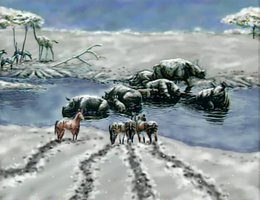
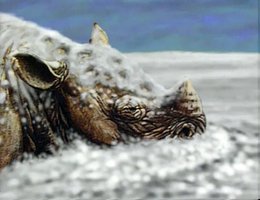
Twelve million years ago, what became Ashfall was a watering hole in the middle of a savanna—a flat, warm and humid grassland much like some areas of Africa today. The animals would gather here to drink. Hunters would prey on smaller species, sick or young animals. More than 40 species of plants and animals were common visitors or residents.
All of that changed one day. Hundreds of miles to the west, in what is now Idaho, a huge volcano erupted. Scientists now estimate that this eruption was at least 100 times greater than the recent Mount St. Helens eruption. The volcanic ash from the ancient eruption was carried by the winds across the plains and eventually deposited approximately one foot of volcanic ash dust over much of northern Nebraska. The volcanic ash began to blow around like fresh snow. Eventually the high ground was blown free of ash, but low-lying areas, like the watering hole at Ashfall, were filled to depths of eight feet or more. The scene has been described as a gray blizzard.
When this ash is examined under a microscope, it is seen to be made up of millions of sharp, jagged particles of rock and glass. The animals around the watering hole could not help but breathe in these rough particles. Birds and turtles were the first species to die as their lungs filled up with sediment. Musk deer and small carnivores were the next to die. The larger animals were also having trouble breathing. Inside their bodies, their bones were growing abnormal patches of highly porous new bone matter, especially around the lower jaw and on the shafts of major limbs and the ribs. This is evidence that they were not getting enough oxygen. Over the period of a few days to a few weeks, horses and camels began to die, and scavengers would circle in, gnawing the flesh down to the bone.
Finally, even the largest animals had to return to the pond to drink. A herd of nearly 100 rhinos must have shuffled through the clouds of blowing ash to get to the pond. Some mothers had baby rhinos by their sides. But the ash became too much for even these large animals. Some of the mothers died. Their young still tried to nurse, and then they died as well.
Gradually, more ash drifted in on the wind, and the entire death scene was buried. Probably because of the danger that the ash presented to later scavengers, the site remained relatively untouched for the next twelve million years.
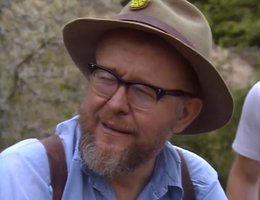
In 1971, University of Nebraska State Museum paleontologist Michael Voorhies was walking with his wife Jane through a series of gullies on Melvin Colson’s farm in northeastern Nebraska. What had attracted Voorhies to this area was that the Verdigre Creek and its tributaries had done a good job of eroding away the top layers of much of the land around the area. Voorhies had been searching the area since 1969 and had found a number of fragmentary fossils.
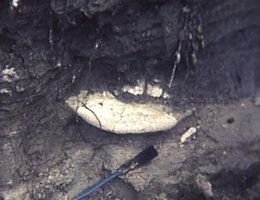
Eventually, they moved their attention away from what they thought was going to be the most promising site, a 100 foot high cliff with a layer of hard sandstone at the top. They started to wander down a series of less spectacular outcrops. One gully had just been heavily eroded by torrential rains. Peeking out of the wall of the gully was a small piece of white bone surrounded by what looked like ash. Voorhies recognized it as part of a skull of a baby rhinoceros.
"Excitedly, I brushed the ash away from the little skull," Voorhies recalls, "first from the oversized teeth, then farther back looking for evidence that the rest of the skeleton might be there. It was. Just as the old song has it: ‘The head bone connected to the neck bone, the neck bone connected to the backbone, the back bone connected to the hip bone...’ "
Dr. Voorhies had begun a once-in-a-lifetime experience.
What made the site so unusual is that the baby rhino, and most of the other skeletons discovered later, still had all of their bones connected together. At many other sites, scavengers would tear at the skeletons, throwing bones around a large area. Or other animals would trample over the bones. Sometimes, even early bone hunters would destroy sites to pick up the more "valuable" parts of the skeletons.
"Although it was difficult to resist the impulse to dig straight back into the ash bed and see what else was there," Voorhies says, "past experience had taught me that this would not only have endangered the fossils (and maybe the digger!) but also would have destroyed important evidence about the origin of the deposit."
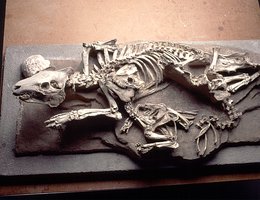
It was six years after the original discovery that Voorhies got a crew together from the UNL State Museum to return to the site. They shoveled off the overburden from 20 square meters and collected several skeletons. Then Voorhies sent photographs and descriptions of that test dig to the National Geographic Society seeking money for a larger excavation. One of the photos showed the skeleton of a pregnant rhino that had the skeleton of her unborn calf still inside her. The Society agreed to support the dig. With that support they explored 600 square meters. They found dozens of other rhinos, horses, camels, birds, turtles and small deer. It was obvious that the site extended well beyond these first digs.
There was a definite pattern to the arrangement of the skeletons that emerged at the Ashfall site. Rhinoceroses were found first, at the top. Then at deeper levels, smaller hoofed animals such as horses and camels, and finally, birds and turtles. The latter were always found at the very bottom of the ash bed. Evidently the small creatures died first, then the middle-sized ones, and finally, the rhinos. The animals definitely did not all die at once and, with the exception of the birds and turtles, were not buried alive.
The remarkable lifelike skeletons, some of which contain stomach contents, give paleontologists an opportunity to reconstruct the life appearance and habits of these ancient animals with an accuracy not thought possible before. Ashfall provides us with the opportunity to experience a sense of discovery of Nebraska’s deep past.
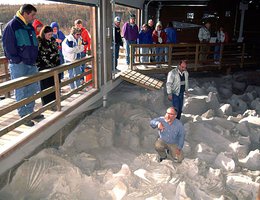
Unfortunately, a time machine does not exist that would enable you to take a journey back 12 million years ago. But, the Ashfall Fossil Beds State Historical Park may be the next best thing.
The park is located between Royal and Orchard in Antelope County in northeast Nebraska. Inside, the animals are still locked in their death-poses and are amazingly well preserved skeletons. Michael Voorhies and his colleagues made the decision to excavate the site and leave the animals in their positions, rather than removing the skeletons to the museum. Visitors can visit this time capsule and view what Nebraska wildlife was like long before modern human beings ventured onto the Great Plains.
Ashfall is unique in that animal skeletons are still joined together in the proper order, not bones scattered over a wide terrain over a long period of time. The silent, ominous cloud of ash that rolled across Nebraska and eventually buried the animals has preserved them and offers scientists and visitors a unique glimpse into their lives.
Today, visitors can step into the "Rhino Barn" built directly over the working excavation. They can meet Morris, McGrew, Dr. Marie, and Delia — all rhinos and horses who are ten million years old. Morris was a male rhino with large tusks and big feet. McGrew was a female rhino with small tusks and an unborn calf. Dr. Marie was a small three-toed horse. Delia was a young horse who still had its baby teeth. You can almost sense the agony the animals must have felt in the last moments of their lives.
Excavation of the Ashfall site continues and hopes are high that a skeleton of one of the large extinct predators, like a saber-toothed cat or a beardog, will be found. Bite marks on bones already collected and fossilized droppings full of chewed bone give proof that big meat-eaters were close at hand. Perhaps some day a park paleontologist will brush away the ash from a gleaming saber of a great rhino-killing cat, exposing it to the sunlight for the first time in ten million years.
The ash bed fossils provide us with much new information about the anatomy and behavior of many members of the ancient grassland animal community.
To see the Ashfall Fossil Beds up-close take a virtual field trip: Ashfall Fossil Beds State Historical Park
You can learn more about Ashfall Fossil Beds and the animals found there at Paleo Sleuths/Ashfall Fossil Beds

