


As World War II ended, a new age began — the Atomic Age. The first atomic bomb dropped on Hiroshima on August 6, 1945, ended World War II and created a new, more nervous age. Very quickly, the Soviet Union also developed atomic bombs. Countries that had been allies against the Nazis were now enemies, each pledged to outdo the other in the battle for political influence around the world. Then both sides developed hydrogen bombs — much more powerful than the original atomic bomb designs. In the era that followed, both world superpowers threatened to use weapons of tremendous destruction as they competed with one another to achieve supremacy of their own political and economic systems. This was a time of tremendous change in the social and political landscape, and Nebraska played a unique role.
The Atomic Era, like many time periods, was both serious and silly. This was a time when young people were so concerned about dying in a nuclear war that they seriously researched bomb shelters. Many families built the shelters. State, local and national officials tried to figure out how the governments and their citizens could survive the awful destruction a nuclear exchange would bring.
There were many who did not believe that any of these civil defense measureswould work in a real nuclear war.
Books, movies and popular culture in the 1950s and 1960s were filled with Atomic Age themes. Some movies were serious films about political issues and nuclear war:
Other movies exploited the fear the audience felt about the Atomic Age, but with much less serious results:
Other critics have suggested that the 1956 movie Invasion of the Body Snatchers was an allegory of communist subversion. The bodies of people who have fallen asleep are taken over by aliens who promise a collective lifestyle free from the individual pains of love, relationships, and ambition. The allegorical message is that we must be ever vigilant. Anyone — a teacher, politician, friend, or minister — could be part of the communist conspiracy.
But life went on. The Atomic Age was also a time of great social change and scientific advances. Things that you are familiar with — like television, Rock ’n Roll, drive-in restaurants (fast foods), hula-hoops, and drive-in theaters — had their start in the Atomic Age.
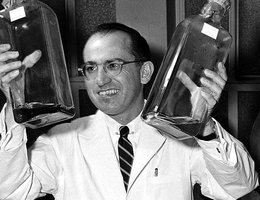
The Atomic Age brought many advances in medicine that helped people live longer lives. One of the greatest victories over childhood diseases was the development of the poliomyelitis (or "polio") vaccine. Polio was a crippling young people’s disease that spread throughout the United States in the 1950s. It caused great fear since every community was affected. Swimming pools closed and people avoided public gatherings, fearing they would catch polio.
At first, the polio vaccine was given as an injection or shot. Then, in 1954, Lancaster County was choosen as a test site for the new Salk vaccine, a sweet-tasting syrup. Vaccination stations were set up in libraries, schools and other public buildings. Children from Lincoln and the surrounding towns gathered at specific times to take their medicine. It worked. By 1955, the Nebraska Department of Health formed a new polio division to help distribute the vaccine statewide.

Life in Nebraska during the 1950s and 60s was determined, in large part, by what happened here during World War II. Life in the atomic age was really a legacy of the war.
For instance, nuclear scientists from Nebraska helped create the Atomic Age as part of the secret "Manhattan Project" that built the first A-bombs during World War II. The planes that dropped the first atomic bombs on Hiroshima and Nagasaki were built in Omaha. The air base where they were built, Offutt Air Base, became a pivotal part of the Cold War. Hundreds of airplanes with atomic bombs were stationed at Offutt during the Cold War under the command of SAC (the Strategic Air Command). The command controlled thousands of other airplanes, submarines and atomic missiles around the world. Some of those missiles were housed in underground silos all across Nebraska. Most of these missiles and bombs were pointed at the Soviet Union.
The fact that there were atomic bombs based in Nebraska meant that there were undoubtedly scores of Soviet bombers, and later missiles, pointed at Nebraska. If an all-out nuclear war had erupted, atomic bombs would have rained down on the state. That fact changed the lives of people living in Nebraska.
Early in the Atomic Age, the government tried to find ways that civilians could possibly survive an atomic attack. Former Nebraska Governor Val Peterson was put in charge of the Federal Civil Defense effort. During his administration the new hydrogen fusion bomb, or Superbomb, was developed. Testing of the H-bomb showed that radioactive particles would travel far from the blast area. Peterson realized that the plans in place at the time wouldn’t work. He came up with plans to evacuate city target areas.
But there were also peaceful affects of the atomic age on Nebraska. One of the first atomic-powered electric generating stations was built near Hallam, outside of Lincoln. This was an experimental plant. It was in service for only two years, and was the first commercial atomic energy plant to be taken out of service or "decommissioned". The highly radioactive nuclear material was shipped to a storage facility. Some nuclear material and parts of the plant were used by other plants. What was left — pipes and equipment that had been exposed to radiation — was sealed up in the reactor containment vessel, surrounded by concrete and buried alongside the generating station. The reactor was replaced by a conventional, coal-fired boiler and the plant is still producing electricity. It’s known at the Sheldon Station.
The Interstate Highway across the state was also a product of the atomic age. Behlen Manufacturing Company in Columbus got a great marketing boost when one of its steel buildings survived an atomic bomb test. And Nebraska was the site of one of the nation’s first protests against the A-bomb race and nuclear war.

